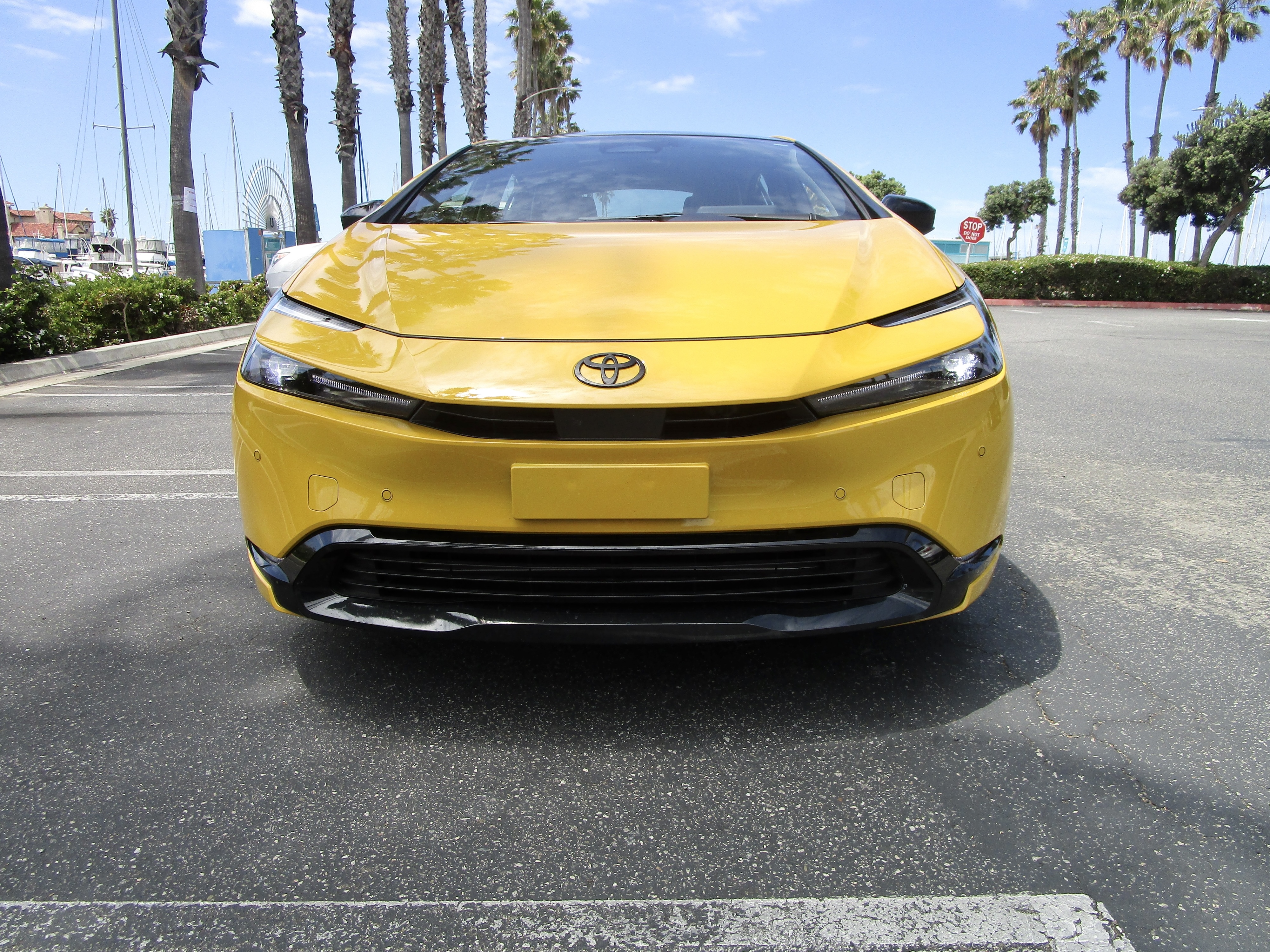
If we told you a few years ago, you could be driving a Toyota Prius that would be turning heads and getting serious double takes, you’d probably had us locked up.
And yet here we are in a cool golden-yellow Prius that looks like it could be some Italian exotic. And the looks are just the beginning of one of the most interesting cars we’ve driven – especially one that earned its accolades being a frugal, slightly agrarian small car. Ready to get your mind blown? Let’s take a test drive!
It’s a Lambo-Prini!

While the new design has been with us since 2023, it still seems to surprise a lot of folks that this is a Prius. In case you missed the update, the low-slung model is 2 inches shorter, 1 inch wider and 1-inch longer than before, but that doesn’t really begin to tell you the story.
Toyota calls the front a “hammerhead” nose, and it does have an evil, predatory look, with slim, squinty LED headlights, and a slender grille that gives it an evil smile. Beneath that, a lower blacked-out grille adds to the aggressive tone.

The sideview really shows off the new looks – a cross between a new Tesla and maybe some swanky Italian supercar brand. While previous Prius models were designed with an eye towards frumpy efficiency, the new one looks like style was the prime driver, with a steeply raked windshield, a small greenhouse, ending in an equally raked roofline.
There are some bulgy fender flares, deep cut-ins in the door and 19-inch alloys that really look meaty. Forget “Save the Planet” – this one’s been at Planet Fitness!

The rearview gives off a futuristic vibe with slender taillights integrated into an LED light bar that spans the width of the hatch. P R I U S spelled out in big block letters looks bold and strong while a subtle PHEV badge lets those in the know that this is the plug-in hybrid model.
Two extra things really made out tester stand out. First, the gorgeous Karashi color paint, (Karashi is a type of mustard used as a condiment or as a seasoning in Japanese cuisine), and second, our tester was the new Nightshade Edition.
Available exclusively in Karashi, Wind Chill Pearl, and Midnight Black Metallic, Nightshade gets the black-out treatment on the alloy wheels, badging, door sills, door handles, and bumper trim. It perfectly complements the Karashi color, and it really is one stunning Prius!
Low-Slung Sportiness

The inside echoes the outside’s racy nature.
Open the door and you do have to bend down a bit to get inside – no surprise with the low-slung exterior. The low height is balanced by a wide horizontal dash, with the new hybrid/EV dash set up we’ve seen on other Toyota vehicles like the bZ4X/Subaru Solterra twins, replacing a single large tablet with a display ahead of the driver and a horizontal touchscreen in the center console.
Settle into the comfy seats, and your Formula One fantasies start with that new driver’s display. Instead of looking through the steering wheel, the display is mounted above the rim – almost like a head-up display. That means you’ll be sitting lower with the thick leather wheel closer to your lap. It takes a few minutes to get used to, but after that it feels pretty cool.

Making the most of the low, wide dashboard is the handsome 12.3-inch touchscreen (lesser models get an 8-inch display), and the big screen is handsome, with standard Wireless Apple CarPlay and Android Auto serving up your choice of connectivity. We do appreciate that Toyota still gives you a volume knob, but it’s a far reach on the lower right-hand corner of the screen. Luckily, you can control volume from a handy toggle on the steering wheel as well.
Below the screen is a dedicated climate control display with easy to access toggle switches, and everything is clearly marked out and super simple to use. Below that there are USB plug-ins for charging (6 total in the car) added storage and nicely sized cupholders. Wireless charging is handled by a cool little holder on the side of the console, and it’s plenty roomy, fitting our iPhone 17 with no problem.

You might expect in a such a futuristic design, there would be a pushbutton transmission like the Honda Passport we recently tested, but thankfully, a stubby little shift lever works great, and still leaves room for some drive mode controls nearby – an improvement over the dash-mounted shift lever on previous Prius models.
You do feel hunkered down in the sleek sedan, but good design means you have reasonable headroom – if you’re over 6-feet tall, it may be a challenge. We also enjoyed the optional panoramic sunroof, which brings in loads of light to the interior. It doesn’t open though; we would have liked that.

The front seats are supportive, featuring a driver-side power lumbar support and in our tester were heated, along with the steering wheel. The rear seats suffer a bit in the headroom department, thanks to that sharply angled roof line, but if carrying larger adults is part of your drill, you’d probably want to look at the Corolla Cross Hybrid or the all-new RAV4.
The large hatchback gives easy access to the cargo area, and even with the larger battery pack for the Plug-in Hybrid, space is quite good, and the 60/40 rear seats fold flat to create an impressive amount of room.
Plug us In!

Driving the PHEV model levels up the fun.
It starts with a bump in horsepower. With an already impressive 196 horses in the regular Prius, the Plug-in Hybrid soars to 220 net combined horsepower. This improves the 0-60 time about a half second to the mid-6’s for Plug-in, versus low 7 seconds for the standard Prius model.
(a note: while that 196 hp is for an AWD model, the Plug-in Hybrid is offered exclusively with front wheel drive.) Both feel quite sporty, and with electric motors pumping impressive low-end torque, and the low seating position, it feels even faster than it actually is.

Of course, the big difference with the Plug-in Hybrid is that you get an impressive all-electric driving range, thanks to a lithium-ion battery pack. According to the EPA, our Nightshade tester can go for 40 EV miles before needing to dip into the gas engine, while lighter XSE trims are rated for up to 44 miles.
Add in the frugal hybrid gas powertrain and Toyota says the plug-in has a total range of up to 600 miles – you’ll be needing a pit stop before your Prius does! When you do decide to charge up the system, expect to need about 4 hours from a 240-volt plug. Another cool feature, optional roof-mounted solar panels can send power to high-drain accessories like the climate control system.

While we loved the zippy performance, the Prius has even more to offer. The low-slung overall height combined with the 19-inch wheels gives responsive handling, and it’s fun to toss around on twisty roads or attack your favorite on-ramp. The ride is also impressive, being smooth and controlled even on those big rims, and the Plug-in settles down to a notably quite ride on the freeway.
Braking is strong too, and in certain driver modes, you get enough regenerative braking that you can almost one-pedal drive like many true EV’s – just ease off the gas and the system starts slowing the vehicle down and recharging the system. This is having your cake and eating it too.

Toyota’s Safety Sense 3.0 system comes along for the ride, including Blind Spot Monitor with Rear Cross Traffic alert, Front Cross Traffic Alert, Lane Departure Warning and Lane Keeping Assist, adaptive cruise control and Traffic Jam Assist. One interesting feature, with the gauges above the steering wheel, there’s now a little sensor that tracks your eye movements, and if it notices you’re looking away for more than just a few seconds, it issues a warning.
How much to plug in to a Prius PHEV?
Toyota has elevated the game with the new Prius, but it still keeps the common-sense pricing on the new models. If you can live without the Plug-in model, the standard Prius hybrid starts at just $28,550. For a sleek looking, fun to drive small car that nets you around 57 mpg, that’s amazing value.
Our Prius Nightshade Plug-in Hybrid (a Nightshade model is available on the regular hybrid as well) is the next to the top-of-the-line-up and starts at a still reasonable $37,795. Our tester added some tasty options, including Digital Key capability, ($275), 12.3-inch Toyota Audio Multimedia ($610), Fixed Glass Roof ($1,000) and $110 worth of accessories. Add in $1,195 for Destination, and we rang the bell at $41,304.
The main competition comes from the Plug-in’s sibling, the standard Prius hybrid. Build one up in the same Nightshade trim and you’re looking at $36,105. Is the added range and performance worth a $5,000 upgrade? We think that depends on if you can actually take advantage of cheap charging or just want a greener driving experience.

Finding another plug-in competitor is slim ‘pickins. So, along with the standard Prius hybrid, we’d also take a look at the Honda Civic Hybrid. No plug-in available, but the performance is very sporty, and it’s a handsome sedan with all the Civic goodness we’ve come to expect. Comparably equipped at $35,425 it’s a strong competitor – but alas, not a plug in.
Stunning looks, spirited performance and up to 40 pure EV miles on a charge and a total range of 600 miles, the 2026 Toyota Prius Nightshade PHEV is a win-win-win!

Leave a Reply