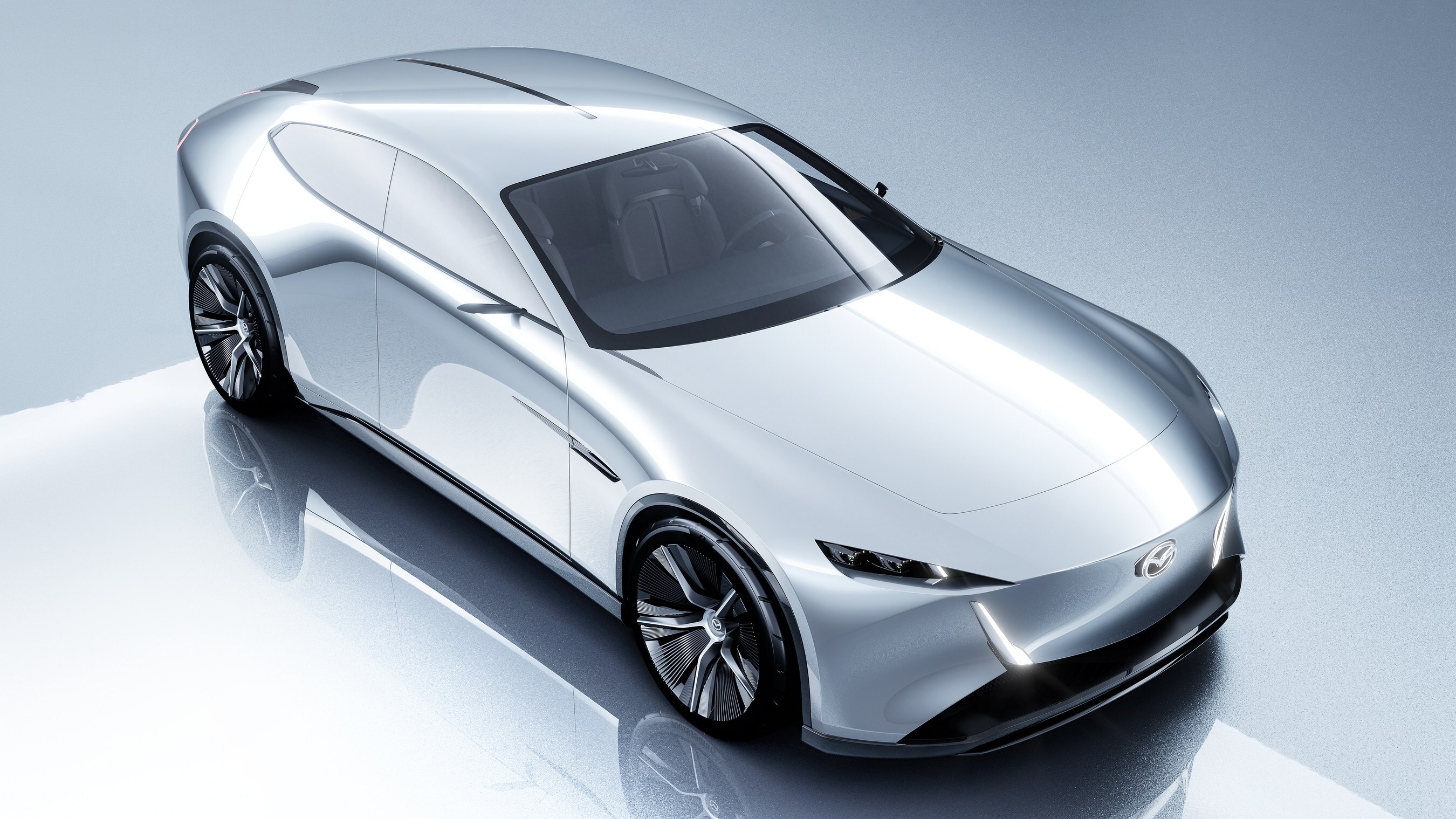
The 2025 Japan Mobility Show is bringing a number of stylish concepts to attendees and this year’s iteration is promising to be a key event. Mazda is one of the companies in attendance looking to make a splash at the show and it has decided to bring two new Vision concepts to the stage for the first time ever after a brief teaser campaign.
Mazda Vision X-Compact

The Vision X-Compact might seem like any other show vehicle but Mazda is also attempting to go in a different direction with this particular concept. “Picture this: you are behind the wheel, but you are NOT alone. There is a warm presence not intrusive, just aware. It might say, ‘Hey, remember that café you mentioned last week? There is a fun backroad that will get us there. Way more interesting that this highway.’ So you make the turn, and hear, ‘Ooh, nice merge!’ Then gently, ‘Blind spot, left side.’ And your little adventure continues.”

That opening statement came from Kaisei Takahashi the X-Compact’s designer who chose to use this odd icebreaker to describe the car’s AI which could be your “virtual boyfriend or girlfriend” while also being a close companion on long journeys. The AI is also an evolution of Mazda’s long-running Jinba Ittai philosophy that attempts to make the driver one with the vehicle.
The creepy AI implications aside, the concept itself is the latest iteration of Mazda’s long-running Kodo design language and it appears to be about the size of a Mazda2 (one of the most underrated compacts that ever went on sale in the U.S.) with the hatch like profile being accented by a bold front grille panel and a sensible rear-end.

The interior has mostly metal body color matching trim with the large speedometer doing its best impression of the one in most Mini products. The concept can seat up to four people and it could be a preview of a future compact model for the Japan market. Performance hardware wasn’t formally announced, but the high 7,700 RPM revline could indicate the presence of a small rotary engine.
Vision-X Coupe

The main event though was the Vision X-Coupe. Introduced by Mazda CEO Masahiro Moro the concept is a stylish four-door coupe that is supposed to provide a glimpse into 2035. The Kodo design we mentioned in the X-Compact is also on display here with the clean grille panel being contrasted by bold fang elements, a wide lower intake, and a pair of slender headlights.

Streamlined bodywork creates a sporty profile and it also sacrifices traditional door handles and mirrors in order to create an even smoother appearance. The tidy headlights and the sloping roofline round out the look and the Vision X pulls no punches about where Mazda is placing a potential production version.
Bigger than a CLS
The Vision X-Coupe is also a pretty big car, it measures 198.8 inches (5,050 mm) long, 78.5 inches (1,995 mm) wide, and 58.3 inches (1,480 mm) tall with a wheelbase that spans 121.3 inches (3,080 mm). These figures not only make it bigger than the axed Mazda6, but more importantly, the Mercedes CLS.
The interior is not awash with screens and while a large one stretches across half of the dashboard, the digital instruments are separated into three distinct “gauges” for a classic analog look. Stylish two-tone upholstery and a baseball style shifter give the cabin a sportier look though the individual rear seats are most likely there for show with more sensible thrones being put into a production version of this vehicle. This would make sense since Mazda could be previewing a Grand Tourer instead of a formal sedan.

Performance for the Vision X comes from a turbocharged rotary engine that’s paired with a small electric motor and a battery pack to produce a combined system output of 503 hp and a pure electric driving range of 99 miles. When the rotary is in the picture, the concept can get a combined driving range of 497 miles.
The lone difference here is that this concept actually cleans the air as it drives along the road thanks to (as the company says) a novel approach “combining a carbon-neutral fuel derived from microalgae with Mazda’s proprietary CO2 capture technology.” Moro explained further stating microalgae absorbs CO2 as it grows and stores oil in its cells. These oils can then be extracted and turned into carbon-neutral fuel. The remaining microalgae is rich in nutrients – such as protein – and can be transformed into food or organic fertilizer.

Meanwhile the carbon-capture technology pulls CO2 emissions from the exhaust with the collected particulates being used to either help grow crops or produce “high-performance carbon materials.”
It remains to be seen if these conceptswill produce definitive production fruit but some of their underlying technologies could make their appearance in future Mazda models.


Leave a Reply