We’re spending the winter in Kona. While images of swaying palm trees, beautiful beaches and rich, dark coffee may fill our heads, we’re actually spending time in the Hyundai Kona. So, does Hyundai’s small crossover create its own kind of memorable experience? Let’s find out!
Neoteric Yellow Zonker

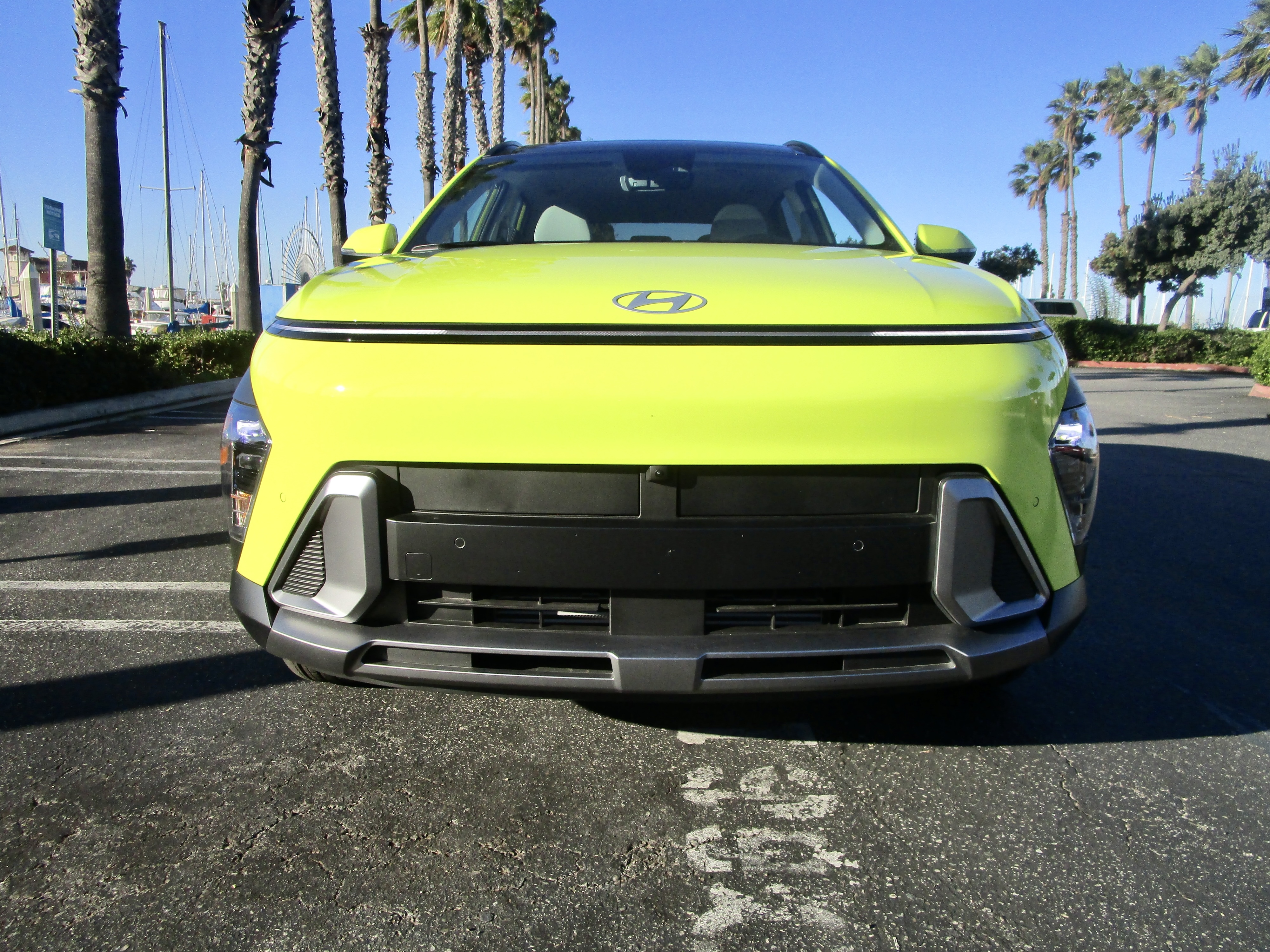
The first thing that hits you about our tester is the bright, highlighter-adjacent tone called Neoteric Yellow. It’s bright and bold and cheerful, and we love it. But we can see it might not be everyone’s cup of tea.
Same with the styling. In a world of small SUV/Crossover sameness, the Kona stands out. Redesigned for the 2024 model year, the Kona boldy goes it’s own way.
It’s interesting too, that the Kona looks to be channeling design cues from the brand’s electric vehicles, including a front end with an LED light that spans across the width, and the headlamps sitting low and to the sides in chevron-shaped panels. A large lower grille, with some contrasting metallic trim for an upscale look.

We think the profile may be the best view of the Kona. It sits tall with a raked-back windshield and equally rakish rear window, that reminds us of the profiles you see on BMW’s X4 and sporty variants of Audi and Mercedes SUV’s. That sporty greenhouse drops down to massive blacked-out wheel arches, sharp accent lines and cut-ins in the doors that look modern and fresh. And the perfect finishing touch are massive 19-inch throwing star wheels.
The rear also features a simple, clean EV look, with an LED taillight that spans the rear hatch, and K O N A spelled out in big block letters. The lower contrasting fascia also features a metallic look that adds some bling. The rear taillights wrap around from the sides and sit low on the body, echoing the front, and we think that they can look a little awkward from certain angles. Overall, though, we think the Kona is a great looking vehicle!
A Bite of the Apple

The Kona’s interior reminds us of our favorite Apple Store. Crisp, lots of white, clean surfaces, and loads of tech on display.
And it’s presented beautifully – your first thought is that this looks much more expensive and elegant than an affordable crossover/SUV. Part of that comes from a tasteful color scheme of light and contrasting medium gray. A wide horizontal dash design also makes the interior feel spacious and open.
Adding to the feel-good factor are dual 12.3-inch display screens that are seamlessly connected to create a wall of digital goodness – and it looks like it belongs on a BMW or Audi!

In front of the driver is an adjustable gauge display, and we like the simple graphics that keeps things clear and friendly. And we love the gauge face that turns into a camera display when you’ve signaled for a turn. This started out as a high-end feature in Genesis vehicles but has migrated down to the less-expensive Hyundai models – and it really makes you feel like you have something special.
The partner 12.3-inch display has a wide-screen horizontal feeling that looks state of the art and makes features like Apple CarPlay and Waze look terrific. While it is tech heavy, we also like that Hyundai kept knobs for volume and tuning, along with dedicated pushbuttons below the screen for key info-tainment features. Below that, a simple and easy-to-decipher climate control system makes it easy to stay comfy.

Below that you have a handy panel for USB ports, a wireless charger, and below that, a circular drive-mode flanked by controls for things like the heated and ventilated seats, heated steering wheel and parking view camera.
Adding to that upscale vibe, it doesn’t say Hyundai or show the logo anywhere inside – the steering wheel has a slim horizontal line that echoes the “light bar” designs on the front and rear of the Kona.

Another interesting touch on our tester, choosing gears is by a shift-by-wire lever that’s located on the steering column. To access the gears, you twist the knob forward for drive, and counterclockwise for reverse. We’ve been getting used to this system in other Hyundai/Kia vehicles, and it’s pretty convenient.
And another bonus, by moving the shift lever, you get a spacious center console. We like the overall thinking here – by breaking up the functional features you don’t overload the driver by trying to put everything in one place. It makes the Kona an easy-to-drive from the get-go kind of vehicle.

It’s friendly for passengers, too, with a surprisingly spacious rear seat that happily accommodates full-size adults. The rear seats also recline for added comfort, and fold forward to create a flat floor with impressive cargo space. On our Limited tester, that was made all the easier with a hands-free, power rear hatch – another upscale feature.
That’s just the start of luxurious accommodations, as our Limited tester also featured dual-zone climate control, surround view monitor, remote smart parking assist, LED interior lighting, Bose premium audio, wireless phone charger, navigation, wi-fi hot spot, and more. This is not an expensive car, but you feel absolutely spoiled!
Turbo Time

Driving the Kona shows off even more refinement.
While base models feature a 2.0-liter, 4-cylinder, the 147-horsepower model may be frugal but pretty pokey. We’d opt for our tester’s 1.6-liter, turbo 4-cylinder with a strong 190 horsepower and impressive 195 lb.-ft of torque starting at just 1,700 rpm. With a combined EPA rating of 26 mpg, it’s fuel efficient, too.
When the all-new Kona appeared in 2024, the turbo model changed from a 7-speed direct sequential transmission to a more conventional 8-speed automatic. We really miss the 7-speed – while it could be a little jumpy at low speeds, shifts were lighting quick, responsive and made the Kona one of the most fun small SUV’s you could drive.

Well, since the Kona’s mission isn’t really about appealing to driving enthusiasts, the new automatic makes sense. It’s much smoother, probably more efficient and overall, a nice experience – but we can’t stop feeling that it’s lost some of its character in the compromise. In a way, it reminds us of the Subaru Forester we tested recently, same feeling – more refinement, but missing some of the quirky charm it had before.
It’s still fun to drive, the turbo motor is peppy, and especially in Sport Mode, and the engine likes to pull hard and sounds good doing so. You even have paddle shifters to add to driver involvement.
The Kona’s size makes it great for zipping around town and nabbing those tight parking spaces. And with the tall ride height, the ride is smooth, but not sloppy. Grip is good as well with our tester’s all-wheel-drive, and with a compliment of driver assist features including standard Adaptive Cruise Control, Forward Collision Avoidance and Lane Keep and Following assist, the Kona is a confident long-distance cruiser as well.
Our Limited tester also featured added goodness with Blind Spot Monitor and Warning, Rear Cross Traffic avoidance and Alert, Rear Occupant Alert and Safe Exit Warning.
Helping in the daily drive, our tester also enjoyed a 360-degree, Surround View Monitor, and Remote Smart Parking Assist that lets you move the vehicle backward or forward out of various parking scenarios – even if you’re outside of the vehicle. We think this level of features and tech in a small, affordable, SUV is astounding – this was all luxury brand stuff just a few years ago!
How Much for some Kona Time?

We think the Kona’s value is as impressive as the style and tech.
You can get into a Kona SE as low as $25,350 for a front wheel drive, non-turbo model, and considering the looks, interior room, loads of tech and 10-year/100,000-mile warranty it’s a no brainer and a great buy.
Our Limited AWD model is the top-of-the-line in the non-EV lineup and starts at $34,150. Add $500 for the eye-searing Neoteric Yellow paint, $240 for carpeted floor mats, and $1,495 for destination, and we rang the bell at $36,385.
Competitors would include the Mazda CX-30. At $39,990 it’s more expensive, but that powerful 250-horsepower turbo engine and great chassis is very attractive. Along with that higher price, we find the overall rear seat room and cargo space notably less than the Kona.
We’d also check out the sibling Kia Seltos at $33,380. With the same running gear as the Kona, the drive is similar, but the design is a little more conservative.
Even if you can’t get to Hawaii, you should spend some time in Kona. Great looks, fun to drive, with a luxurious and tech-heavy interior, the 2026 Hyundai Kona is an impressive value and one of our favorite compact crossover/SUVs!


Leave a Reply