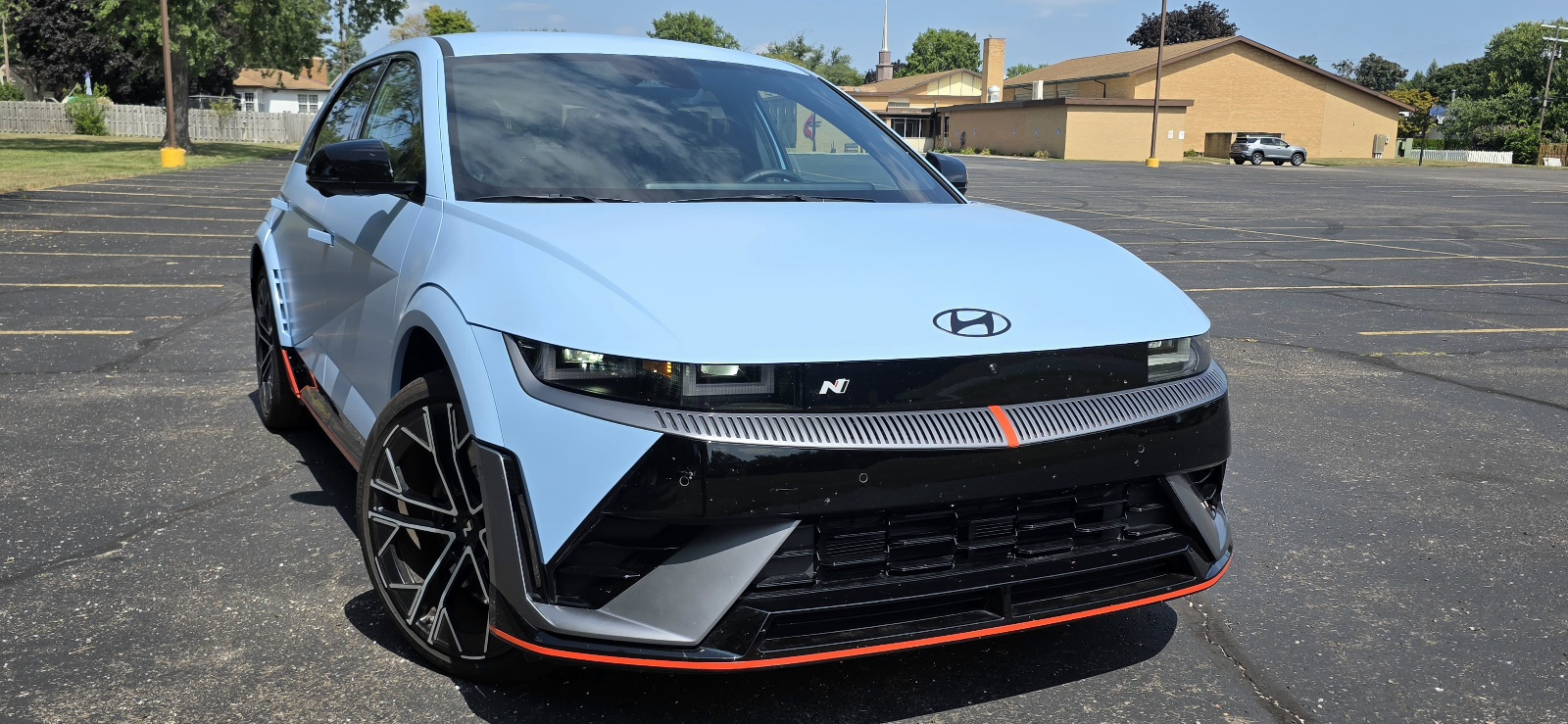
The 2026 Hyundai Ioniq 5 N continues to feel like it’s the product of a mad scientist’s experiment. Take the typically mundane Ioniq 5 EV and throw every feasible performance upgrade at it to try and make it a track monster.
The upgrades certainly leave their mark, but with the Genesis GV60 Magma preparing to enter the market, is this spicy Hyundai still the best route to performance? Or has it been surpassed by its Genesis counterpart?
Light updates fuel Ioniq 5 N updates

Hyundai chose to keep updates light on the Ioniq 5 N for its second model year of production. A NACS port is standard, with adapters available for Level 2 and Level 3 charging. The Drift mode optimizer also gets nine more modes for owners to choose from (overcomplicating it in the process).
But the exterior continues to project a futuristic, albeit boxy image, with the front of the N getting a tougher-looking front end and a large rear diffuser that work together to not only improve the EV’s aerodynamics, but also help keep it planted on the ground. A roof spoiler is included too, and the N even gets splashes of red accents to complement the blue our tester had (other colors are available).

In contrast, the GV60 Magma feels slightly more subdued. The exterior styling is also heavily reworked, but some of the brutalism seen in the Hyundai is dialed back a bit in the Genesis. The front and rear continue to be tweaked for aerodynamic performance, but the roof spoiler looks better here, and the Genesis wheels also pop more than the Hyundai’s.
Choices were made; were they the right ones?

Slip inside the Hyundai, and you’ll find that the interior continues to be a mixture of performance and simplicity. The front sport seats of our tester were very supportive, and we liked how much leg and knee room we had in the front seats.
A set of 12.3-inch screens provides instrumentation and infotainment functions, and the setup continues to blend cleanly into the dashboard. The GV60 Magma uses the same core setup, but its higher price point and luxury focus lift its interior above the Hyundai in amenities and quality. The GV60’s funky ball-style shifter continues to be a highlight and allows the Genesis to have a potent conversation starter.

The Hyundai makes up for it in rear seat room, with the boxy roofline allowing it to have slightly better headroom than the Genesis, which can be tight for taller occupants due to its sloping roofline. Our main complaint with our tester was just how overcomplicated its N mode was. You have plenty of menus to navigate through when trying to tailor the car’s drive characteristics, and with some of the sub-menus requiring multiple inputs, it’s best to set them up while you’re parked.
Ioniq N still has wicked performance

The 2026 Hyundai Ioniq N and the Genesis GV60 Magma may have a few differences, but both are powered by the same dual-motor EV setup that makes a combined system output of 601 hp for most driving situations. This default amount of power was adequate for most of our tester’s visit, with the EV having ample amounts of acceleration.
Buyers looking for more power will have to activate the N Grin Shift system (Boost mode in the Genesis), which causes power to temporarily go up to 641 horsepower. This shot of power is meant to be used in short bursts, and if you choose to use it, the system will make you wait a few minutes after you do so to help give the components a chance to cool down.

Handling in our tester was sprightly, but the Ioniq 5 is a pretty porky EV, and you can certainly feel its weight sometimes when tossing it through sharp corners. All-wheel drive is standard, and Hyundai says the Ioniq 5 N can make the sprint to 60 mph in 3.0 seconds. The EPA says that the Ioniq 5 N can get up to 226 miles of range in ideal driving conditions, but during our time with it, we managed to get to 190 miles of range before our tester needed a charge. The Ioniq 5 N also comes with a few gimmicky sound modes, with the EV not only being able to imitate the Elantra N’s 2.0-liter turbocharged four-cylinder
Value Quotient
Pricing for the 2026 Hyundai Ioniq 5 N continues to be a simple and very straightforward affair, with only one trim to choose from, which starts at $59,900 before any taxes and fees are factored in. The only major option our tester had was our Performance Matte Blue paint, which is a $1000 option. That caused the final as-tested price to go up to $62,550.
That’s noticeably more expensive than the GV60 Magma, which starts at $69,950 and can go over $70,000 with options. The main caveat here is that the Magma has extremely limited availability, with the model only being available in California, New York, and New Jersey. It’s not known when Genesis will expand the Magma’s availability, but look for more information on that to be released soon.
In the meantime, if you’re looking for something that has wider distribution and is available in more states, the 2026 Hyundai Ioniq 5 N can help provide that jolt of electrified performance while also showing off its track prowess at the same time.
Leave a Reply